

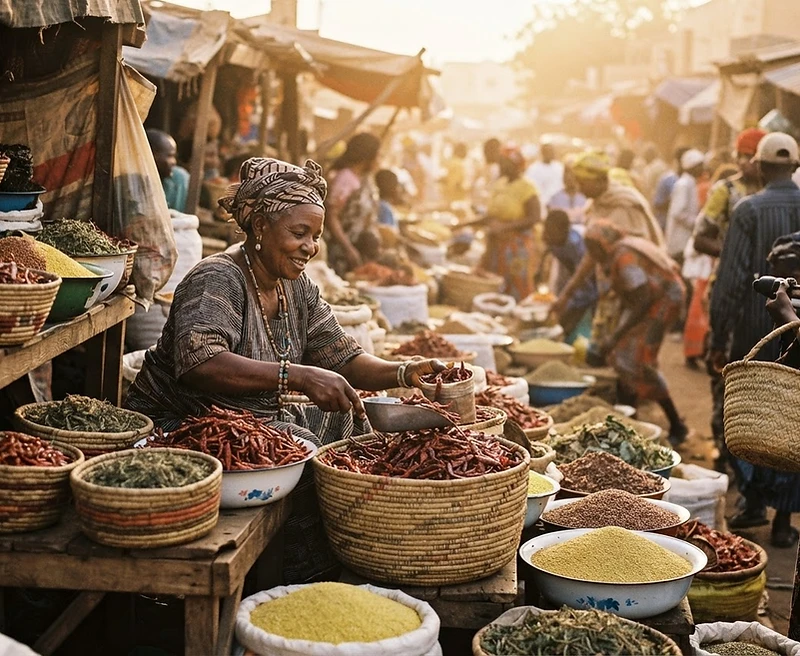
Why Africa Is Not One Cuisine
Say “African food” and most people immediately form a picture.
Perhaps it is jollof rice. Plantain. A rich stew. Something spicy.
But there is a problem with the phrase “African food”.
Africa is not one cuisine.
It is a continent of more than 50 countries, thousands of communities and culinary traditions shaped by climate, religion, migration, agriculture, trade and history.
To understand African food, we have to start by appreciating just how different those traditions can be.
Travel north
In Morocco, Algeria and Tunisia, you enter a world of couscous, preserved lemons, olives, harissa, merguez, chermoula and fragrant combinations of cumin, coriander and warm spices.
Travel east and the food changes.
Ethiopia has injera, the beautifully sour fermented flatbread traditionally eaten alongside richly spiced stews. In neighbouring countries, grains, legumes and spice traditions take different forms again.
Along the East African coast, centuries of Indian Ocean trade brought African, Arab, Persian and Indian influences together.
That history can still be tasted.
Chapati appears across countries including Kenya, Uganda and Rwanda. Coconut, cardamom and other spices tell stories of generations of movement and exchange.
Then there is West Africa
Senegal, Ghana and Nigeria share ingredients and culinary connections, but their cuisines are far from identical.
Even one dish can start a continental debate.
Jollof rice.
Nigeria, Ghana and Senegal each have their own relationship with it—and suggesting that one version is definitively superior is an excellent way to start an argument at dinner.
Beyond jollof are extraordinary traditions built around peppers, groundnuts, fermented ingredients, grains, beans, leafy vegetables, seafood and grilled meats.
Suya in Nigeria brings another flavour entirely: smoky meat covered generously in a distinctive peanut-based spice mixture.
Travel south and things change once again.
South Africa alone gives us dishes and traditions as varied as bobotie, chakalaka and bunny chow—foods shaped by African, Dutch, Cape Malay and Indian influences, among others.
Geography changes the plate
Much of this diversity makes sense when you look at the continent itself.
Africa contains deserts, tropical forests, mountains, grasslands, enormous lakes and thousands of miles of coastline.
People cook with what grows around them.
Where cattle thrive, dairy and meat may become important.
Along coastlines, seafood becomes central.
Elsewhere, millet, sorghum, cassava, maize, rice, beans, plantain or yam might provide the foundation of a meal.
Then people move.
Traders arrive.
Empires rise and disappear.
Communities migrate.
New ingredients enter the kitchen.
Recipes change.
Food becomes a record of history.
Why this matters to Farin Road
At Farin Road, this diversity is precisely what makes African cooking exciting.
We don't want to put an enormous continent under one convenient culinary label.
Instead, we want to explore it.
One menu might take inspiration from Nigeria. Another dish might lead us towards Rwanda, Ghana, Ethiopia, Morocco, Mozambique or South Africa.
Sometimes those traditions meet Scottish ingredients and modern European techniques.
But understanding where the food came from comes first.
Because once you stop thinking about “African cuisine” as one thing, an extraordinary culinary landscape opens up.
There isn't one African food story.
There are thousands.
And we have barely started tasting them.


